
Making the work people do count
Individual contribution is the value people create through their everyday work, behaviours and interactions with others. It is through this contribution that organisations sustain performance, achieve their goals and respond to change.
People contribute by sustaining and improving the work that already matters, while adapting and introducing new contributions as organisational needs evolve. Their contributions are distinct yet interconnected, forming part of the wider system through which organisations create and deliver value.
Making individual contribution count therefore involves more than ensuring that people complete assigned tasks. It requires understanding how their actual work contributes to intended results, making that contribution visible and continually discovering how it can be improved and adapted.
Accountability enables individuals and supervisors to establish shared expectations, examine evidence of actual contribution and take responsibility for what has been agreed.
Learning enables them to discover what is happening through everyday work, recognise emerging patterns, challenges and opportunities, and respond to changing organisational needs.
Together, accountability and learning inform decisions about what contribution needs to be sustained, improved, corrected or adapted.
Connecting Individual Contribution to Organisational Performance
Individual Contribution Management complements organisational performance management. While organisational and Team Goal measures help establish whether intended results are being achieved, ICM focuses on the contribution people make through the work they are responsible for delivering.
The relationship between these two processes is important. Organisational goals provide direction for individual contribution, while evidence and experience from actual work can inform organisational understanding, decisions and adaptation.
This makes alignment more than a matter of assigning goals and targets to individuals. It becomes an ongoing process of establishing and examining how meaningful work contributes to the Team Goals it is intended to support.
Through ICM, organisations can strengthen the connection between their strategic intentions and the everyday contribution of their people, while enabling individuals to exercise ownership, develop their capabilities and continuously improve the value of their work.
Bringing Individual Contribution Management to life through WEBB™
Recognising ICM as a distinct organisational process raises a practical question: how can organisations manage it deliberately and continuously?
WEBB™ is a methodology designed to help organisations do precisely that.
WEBB™ recognises that individual contribution takes place within the complexity of everyday organisational work. People exercise judgement, navigate dependencies, collaborate across boundaries and respond to changing conditions. They are not simply executors of predetermined tasks; they exercise agency in determining how best to fulfil their responsibilities and improve their contribution.
Through its four interconnected perspectives, WEBB™ helps individuals and organisations understand the reality of individual contribution:
- Work: What am I responsible for contributing?
- Behaviour: How do I put my contribution into action?
- Proof: What evidence demonstrates my contribution, and what am I discovering?
- Adapt: What must I sustain, improve or change to remain effective and relevant?
WEBB™ translates these perspectives into four interconnected management disciplines that enable organisations to deliberately manage individual contribution:
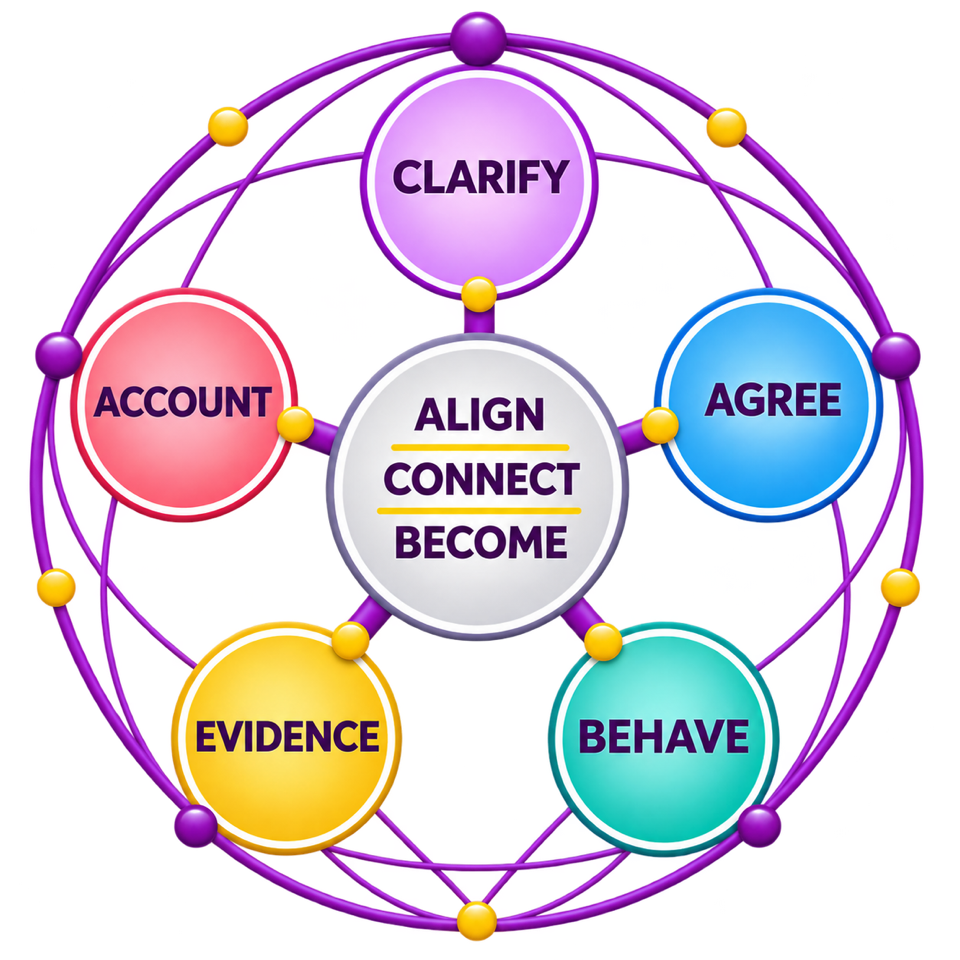
These disciplines form a continuous and interconnected management process, rather than a rigid sequence. They enable individuals and supervisors to manage contribution as work happens, while remaining responsive to changing organisational needs.
In doing so, WEBB™ brings the Accountability pole of organisational performance management to life, complementing the Learning pole of Strategic Performance Management.
The two processes remain distinct, but their interdependencies become more visible and manageable.
We work with organisations to establish, strengthen and integrate Individual Contribution Management into everyday work, aligning individual contribution with Team Goals and enabling continuous accountability and learning.
Our Individual Contribution learning and certification programmes equip HR professionals, Strategy and performance managers, supervisors and other leaders with the knowledge and practical capabilities to manage individual contribution effectively.
We support individuals, supervisors and teams as they apply WEBB™ to clarify contribution, establish meaningful expectations, use evidence and strengthen accountability conversations.